
Hipmunk
Objective-C, Swift, hybrid JS/native, Fastlane, Bitrise
Hipmunk made travel search friendly. Flights were bars on a visual timeline you could sort by “Agony” (a blend of price, duration, and stops), and a goggled chipmunk walked you through the whole trip. I led the iOS team from 2017 to 2019, after SAP Concur acquired the company, eventually as the mobile team’s engineering manager. The app served about 80,000 sessions a month, and its flight search held an NPS around 70.
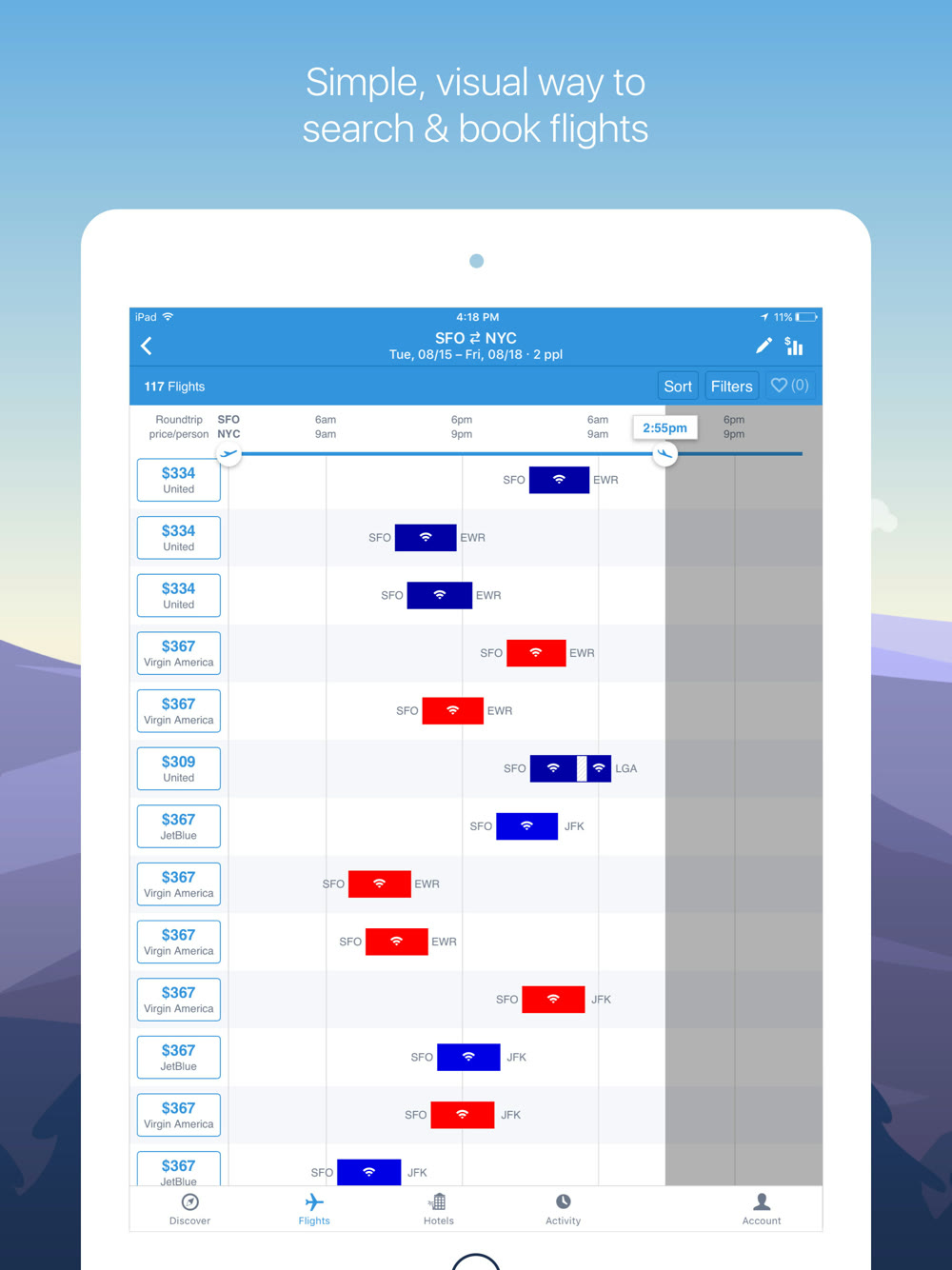
The signature feature: flights on a timeline, so the trade-offs are visible at a glance.
My biggest hands-on build was Book on Hipmunk, native hotel booking end to end. Booking a hotel inside the app meant taking a credit card, so I built the whole checkout: room selection, guest details, card entry, billing address, the cancellation policy you have to agree to, the summary, and the confirmation.
Most of the care went into the payment part. Cards could be scanned with the camera or typed, validated as you go. Card numbers never reached our main API: they went to a separate tokenization host, and everything after that point, saving the card for next time, showing it in your account, charging it at booking, worked from a token plus the last four digits. Returning customers picked a saved card and re-entered the CVV. After booking, members could see the cancellation policy and cancel from inside the app.
Before each release I ran internal playtests, putting experiment-enabled builds on real devices in front of coworkers to shake out the flow.
Flights took the opposite approach. Flight results moved to a hybrid architecture: the web team’s page rendered inside the native app, talking to Swift over a message API in both directions. The web page drove native UI, so tapping sort or filter opened a real iOS picker, and the filter state was mirrored into Swift types on our side. Keeping the two halves in step meant working from a shared, documented message contract with the web engineers, and it let flights ship product changes without waiting on App Store review.
Two minutes of hotel search in the app: query, filters, hotel details, and the booking handoff.
I also owned how the team shipped. I wrote the iOS playbook that set our architecture and testing conventions, automated the release pipeline with Fastlane, moved CI to Bitrise, and ran hiring and the intern program for the four-person mobile team.
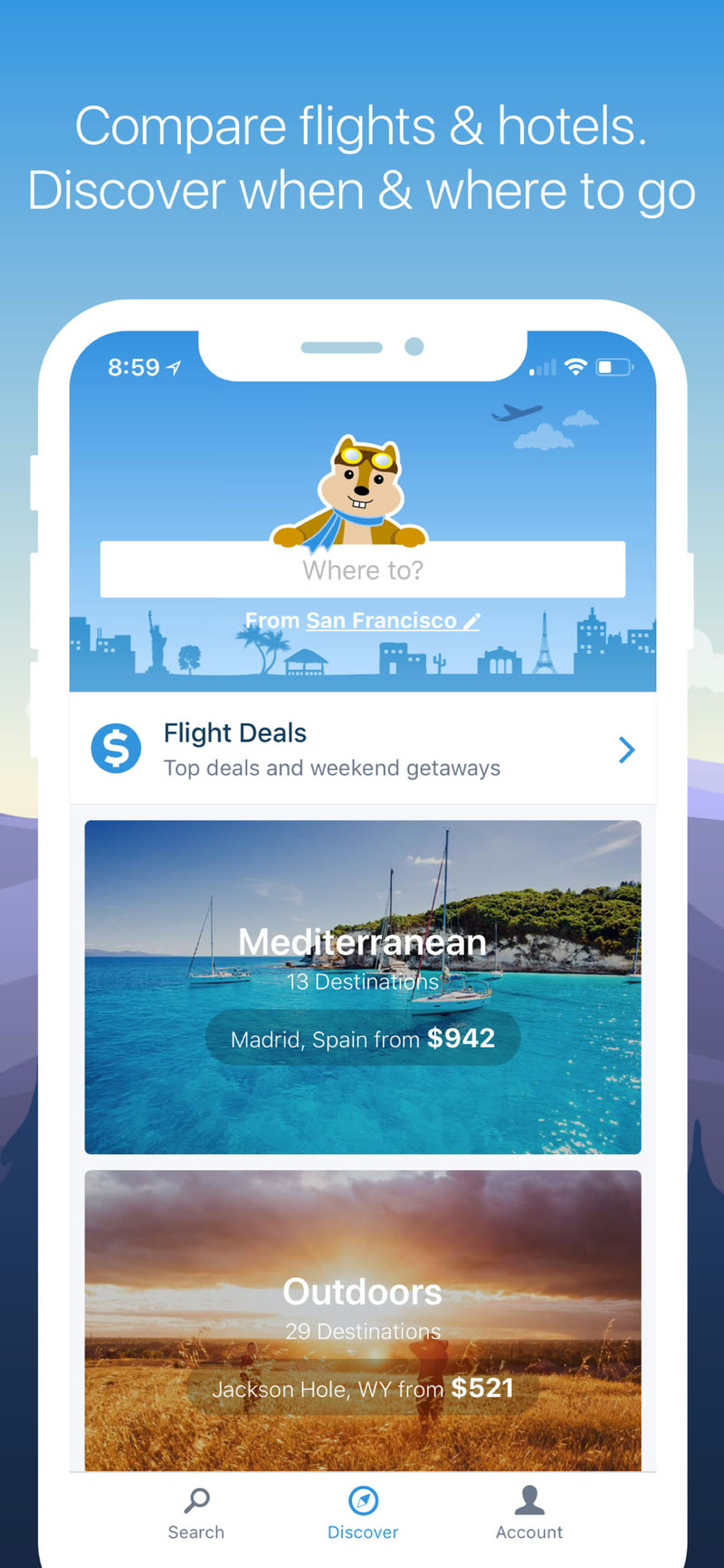
The app in 2019: search, Discover, fare alerts, and the chipmunk in charge.
In June 2019 Apple featured the app in its “Plan Your Dream Vacation” App Store story, alongside Kayak and Hotels.com. That month the App Store listing reached over a million devices and installs doubled.
SAP Concur wound Hipmunk down in January 2020. The chipmunk is still missed.
In the press
I was always a fan of how Hipmunk changed the industry. It was a timesaver and a confidence-booster. You didn't have to double-check their work.
This level of search-detail and quality UX interface is a habit-forming convenience for passengers that helps simplify the sometimes taxing experience of flight shopping. We can expect that it will soon be a core expectation for travel shopping.
Coverage
- Hipmunk iOS update gives travelers everything they need to plan for upcoming trips · PR Newswire, 2017
- Hipmunk enhances flight search with features to make comparison easier · PhocusWire, 2018
- Hipmunk redesigns flight search tool, debuts new meetings function · PhocusWire, 2018
Writing
Two posts from this work:
Related services: iOS apps · An existing product · Fractional work
Tell me what you're working on
I've got room for a few new projects. Write to me and I'll reply with how I'd approach it. I read every message myself.
hello@nerdtower.com